
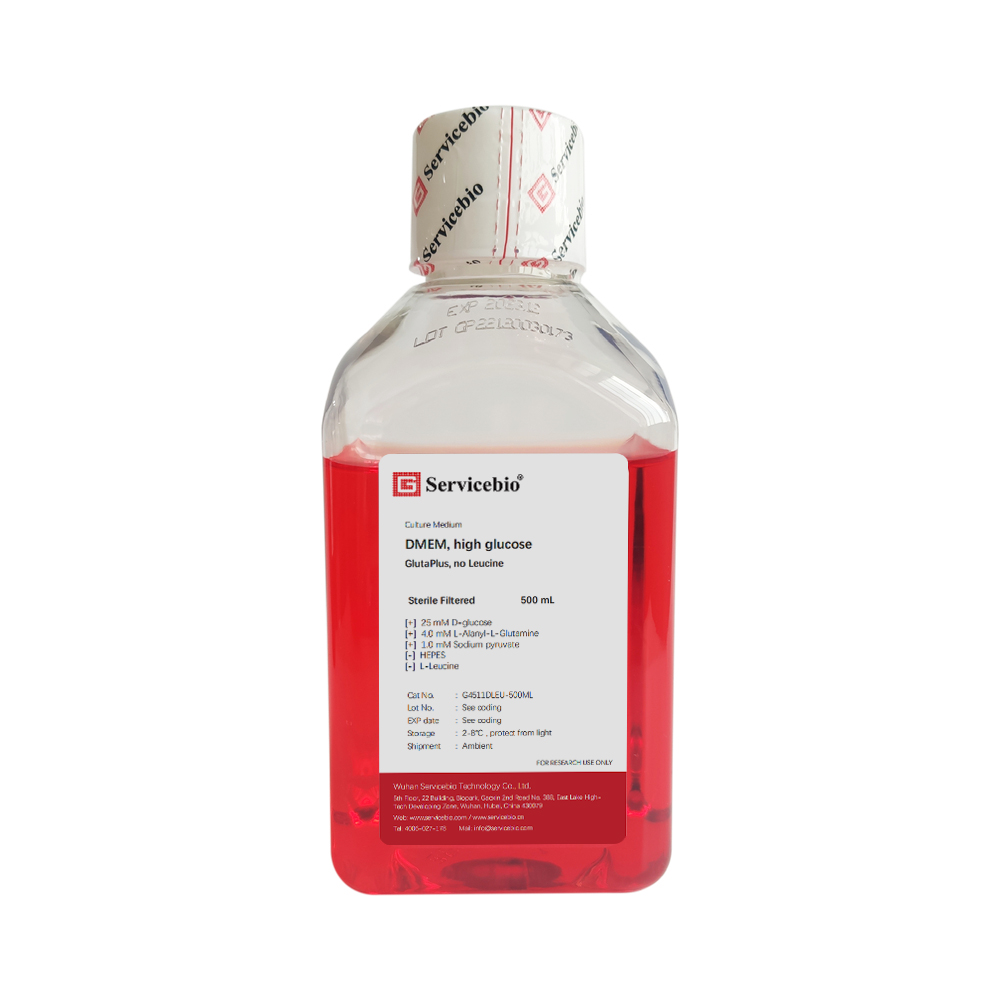
DMEM/High Glucose
DMEM, High Glucose, GlutaPlus, no Leucine
Catalog #: G4511DLEU-500ML
Manufacturer: Servicebio
Price: on inquiry
Product Information
| Product Name | Cat. No. | Spec. |
| DMEM, High Glucose, GlutaPlus, no Leucine | G4511DLEU-500ML | 500 mL |
Product Description
Dulbecco's Modified Eagle Medium (DMEM), is a modified medium based on MEM, is a widely used basal medium for supporting the growth of many different mammalian cells. Cells successfully cultured in DMEM include primary fibroblasts, neurons, glial cells, HUVECs, and smooth muscle cells, as well as cell lines such as HeLa, 293, Cos-7, and PC-12.
The target mechanism of the mTOR complex (mTORC1) plays a crucial role in cell growth and metabolic regulation. In recent years, the activation of mTORC1 mechanism by leucine (Leu) has become a research hotspot (Appuhamy et al., 2012; Averous et al., 2016; Dai et al., 2015; Gu et al., 2022; Kim et al., 2017; Son et al., 2019; Takayama et al., 2018). Therefore, basic research at the cellular level needs to be conducted using cell culture media lacking leucine.
This product is an improvement based on the DMEM high-glucose medium, with L-leucine removed. It is filtered through a 0.1 μm filter and sterilized, with a pH range of 7.0-7.4.
Storage and Shipping Conditions
Ship at room temperature; Store away from light at 2-8℃, valid for 12 months.
Note
1. This product has been filtered and sterilized. Attention should be paid to aseptic operation to avoid contamination.
2. Avoid freezing the culture medium. Freezing may cause precipitation and precipitation of nutrients, which may not be completely dissolved after rewarming, affecting the cell culture effect. In addition, when the medium is stored at 2-8℃, do not store it completely close to the inner wall of the refrigerator to prevent the medium from freezing due to localized low temperature.
3. For your safety and health, please wear safety glasses, gloves and protective clothing.
References
Appuhamy, J.A.D.R.N., Knoebel, N.A., Nayananjalie, W.A.D., Escobar, J., and Hanigan, M.D. (2012). Isoleucine and Leucine Independently Regulate mTOR Signaling and Protein Synthesis in MAC-T Cells and Bovine Mammary Tissue Slices. The Journal of Nutrition 142, 484-491.
Averous, J., Lambert-Langlais, S., Mesclon, F., Carraro, V., Parry, L., Jousse, C., Bruhat, A., Maurin, A.-C., Pierre, P., Proud, C.G., et al. (2016). GCN2 contributes to mTORC1 inhibition by leucine deprivation through an ATF4 independent mechanism. Scientific Reports 6, 27698.
Dai, J.M., Yu, M.X., Shen, Z.Y., Guo, C.Y., Zhuang, S.Q., and Qiu, X.S. (2015). Leucine Promotes Proliferation and Differentiation of Primary Preterm Rat Satellite Cells in Part through mTORC1 Signaling Pathway. Nutrients 7, 3387-3400.
Gu, X., Jouandin, P., Lalgudi, P.V., Binari, R., Valenstein, M.L., Reid, M.A., Allen, A.E., Kamitaki, N., Locasale, J.W., Perrimon, N., et al. (2022). Sestrin mediates detection of and adaptation to low-leucine diets in Drosophila. Nature 608, 209-216.
Kim, J.H., Lee, C., Lee, M., Wang, H., Kim, K., Park, S.J., Yoon, I., Jang, J., Zhao, H., Kim, H.K., et al. (2017). Control of leucine-dependent mTORC1 pathway through chemical intervention of leucyl-tRNA synthetase and RagD interaction. Nature communications 8, 732.
Son, S.M., Park, S.J., Lee, H., Siddiqi, F., Lee, J.E., Menzies, F.M., and Rubinsztein, D.C. (2019). Leucine Signals to mTORC1 via Its Metabolite Acetyl-Coenzyme A. Cell Metabolism 29, 192-201.e197.
Takayama, K., Muto, A., and Kikuchi, Y. (2018). Leucine/glutamine and v-ATPase/lysosomal acidification via mTORC1 activation are required for position-dependent regeneration. Scientific Reports 8, 8278.
For Research Use Only!
Videos
View this product on the manufacturer website (Servicebio) ↗
Request a quotation
Fill in the form and the Envision Sciplus team will reply with a quotation and delivery time.